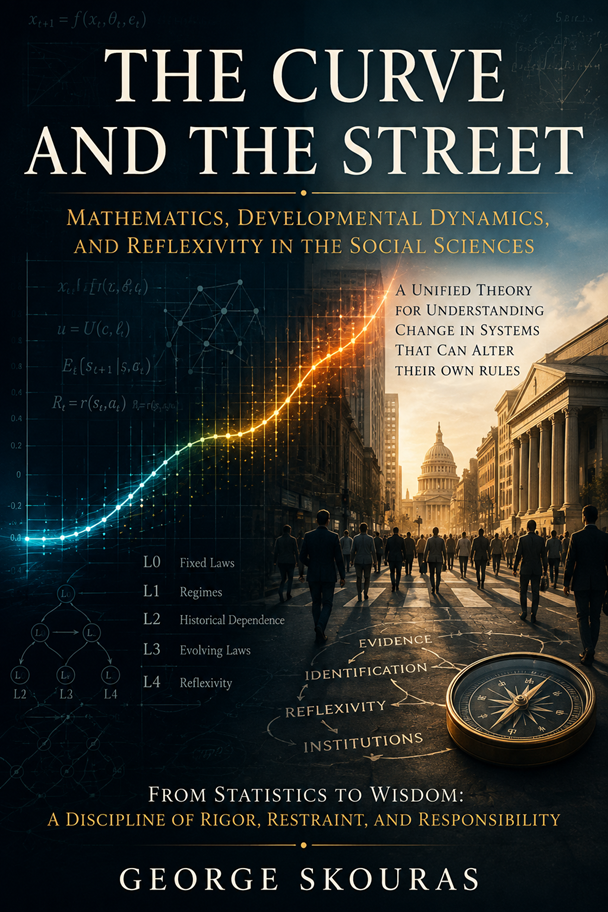
The Curve and the Street examines a central difficulty in the social sciences: mathematical models do not merely describe a passive world. Once adopted by governments, institutions, markets, courts, and algorithms, they can alter incentives, classifications, and behavior—and thereby transform the realities they were designed to explain.
Bringing law, political science, social theory, economics, and statistics into a common framework, the manuscript distinguishes mathematical precision from substantive validity. It asks when formal models clarify social processes, when their assumptions outrun the evidence, and how reflexive feedback changes the relationship between measurement, prediction, and institutional action.
Central themes
- Mathematical rigor and the limits of social measurement
- Identification, causation, and construct validity
- Developmental regimes and institutional change
- Reflexivity: how models reshape the behavior they measure
- Algorithmic governance and responsible model use
- The relationship among law, political authority, statistics, and social knowledge
Intended readership
The manuscript is written for scholars, graduate students, policy professionals, and analytically minded readers working across law, political science, sociology, economics, statistics, public policy, and the philosophy of social science.
Publication status
The manuscript is complete and currently under editorial consideration. No publisher or publication date has been announced.