Dear reader,
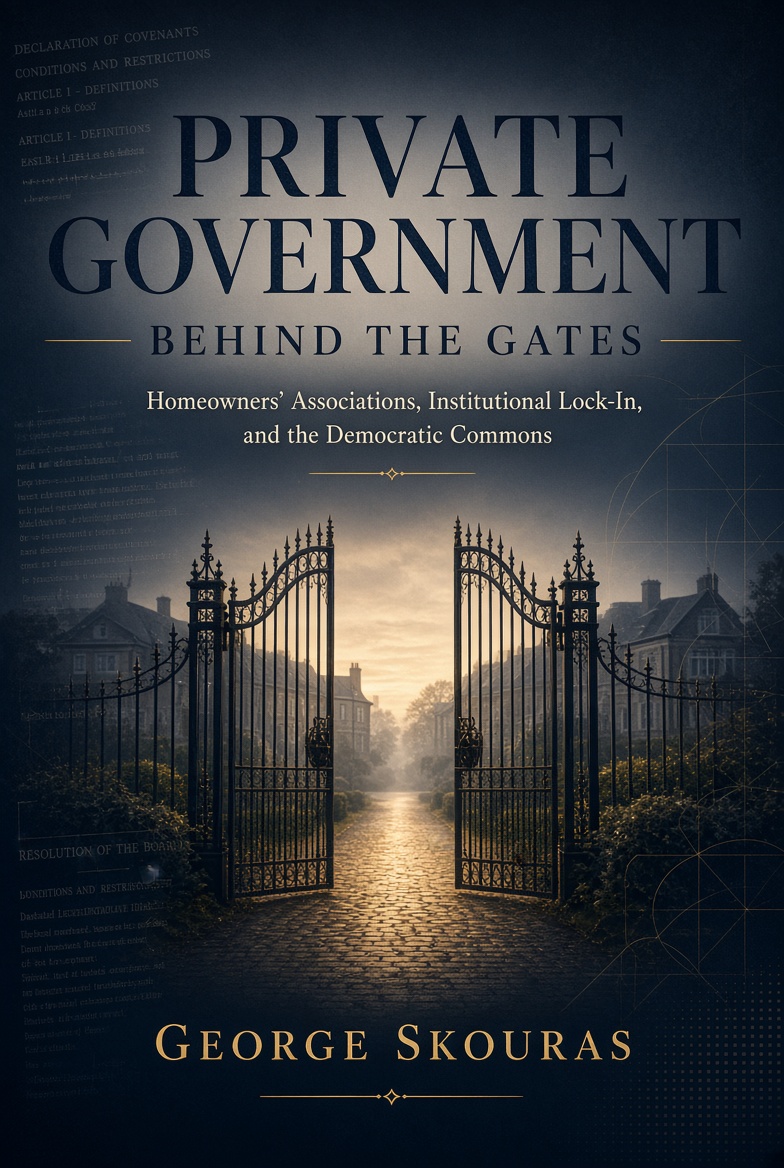
I have completed a new book, Private Government Behind the Gates: Homeowners’ Associations, Institutional Lock-In, and the Democratic Commons. It begins with a question that reaches beyond the visible boundary of a gated community: what makes continuing authority over shared residential life accountable?
A home is a place of security, attachment, and personal choice. Yet ownership can also join a person to an institution with power to collect assessments, make maintenance decisions, enforce restrictions, and administer shared property. Those arrangements can provide services that owners value and protect expectations on which they rely. They also require collective decisions among people who may disagree.
Accepting a set of rules when purchasing a home matters. It does not resolve every question about how those rules will operate years later. Circumstances change. Buildings age. Costs rise. New owners arrive. The authority established by a declaration continues to govern people whose needs and judgments may differ from those of the original participants.
The practical difficulty becomes clear in Maple Court, an invented community used throughout the book. Suppose its 300 homes each carry one vote and an amendment requires 201 affirmative votes. If only 148 owners return ballots, the proposal cannot pass even if every participant supports it. The problem is not simply how many people favor a proposal. It is also how the governing rule counts their participation.
This example does not show that every failed amendment is unjust or that demanding thresholds should always be lowered. Owners have legitimate interests in stability, and minority protections matter. It shows why the design of a voting rule deserves examination alongside the preferences expressed within it.
The same attention to institutional design applies to records, enforcement, and maintenance. Owners need information to evaluate decisions. Boards need workable procedures and resources to carry out shared responsibilities. A remedy should respond to the authority being exercised and the problem it is intended to address.
The book brings property law and democratic theory into conversation with commons governance and an illustrative voting model. It examines selected safeguards in California, Florida, and Texas and considers perspectives from Germany and Canada. It also asks how private developments can coordinate lawfully with surrounding streets, services, and public institutions.
The democratic commons, as I use the term, concerns the conditions through which people can understand, contest, and reshape shared authority. That inquiry respects the commitments that make cooperation possible while asking whether the people governed retain a meaningful part in its future.
I offer this letter as an introduction to the completed manuscript. Publication arrangements are pending, and no publisher or release date has been announced. The cover shown here is the proposed design. The manuscript itself remains offline.
I look forward to sharing further news as the project develops. For now, I invite you to consider how the institutions attached to homeownership can preserve both reliable commitments and a practical capacity for collective self-government.
George Skouras